

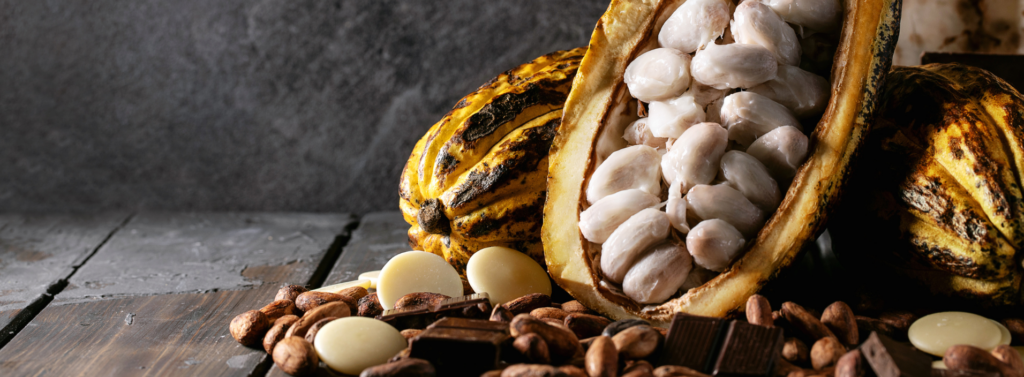




The bean to bar process! Part Two: Chocolate Trees
Published
15 April 2024

Well technically, growing cacao beans.
And we LOVE that you’re here. This was the one that made us realise we knew nothing about the one thing we were treating ourselves to almost everyday…
Before we get into it, if you haven’t read the other posts in this four part series we recommend you start here.
We’re doing a little travelling for this one. It’ll be hot and humid and you’ll be surrounded by the Amazon, the world’s largest rain forest and the most biologically diverse place on Earth. And what we’re looking for is cocoa beans, those small, humble little seeds that gives us one of the most sought after delicacies on the planet.
And that’s because we never knew what the start of the process actually looked like.
What do you picture when someone says the words “chocolate making”?
- Is it a conveyor belt dripping in liters of decadent chocolate?
- Or is it someone hand tempering chocolate to the perfect temperature?
- Do you picture anyone walking through a field of chocolate trees and finding chocolate fruit that’s ready for harvest?
We pictured conveyor belts of chocolate, thousands of identical blocks churning out of giant machines being filled, smothered and just dripping in glorious molten chocolate. But never were we told to picture where exactly that chocolate came from.
So that’s right – This one’s about Chocolate Trees.
And we’ll name them properly soon, but honestly we had no idea that the chocolate making process even started by growing a tree, let alone what that plant was called or what it even looked like.
And the reason we want to start here and focus on chocolate trees, is because all consumers have been told to focus on is the part where the factory already has the chocolate. Never the trees or the origin of their chocolatto the point that if you showed most people the fruit that chocolate comes from, they most likely wouldn’t identify it. And THAT is what we find fascinating.
And yes all we’re going to do this part is talk about trees. But bear with us. it grows.
And so before we get into what the tree actually is, we have to ask can you name it? And can you picture it?
For a different perspective, when we’re children we’re taught where some foods come from:
- Cereals and Breads come from wheat, and most of us could probably picture a wheat field.
- We know milk comes from cows, goats, almonds, soy beans
- Jam comes from strawberries or raspberries, some form of fruit! And for all the fruit and vegetable we eat, we have some idea of what their plant looks like.
- As adults when we discover wine and alcohol –
- and then we learn that beer comes from grains,
- vodka from more grains,
- wine from grapes
- We know that grapes come from a vine and again grains grow in a field
- But chocolate! The one thing that many of us would have been exposed to since childhood. WHERE DOES CHOCOLATE COME FROM?
The Theobroma Cacao Tree

It comes from cocoa beans slash cacao beans (it feels like an anticlimax but stick with us).
These beans are the seeds of the fruit that grow on the cacao tree (formally knows as the Theobroma cacao tree.)
It’s a small evergreen tree, only 6 – 12 m tall, with lush green leaves that could be as small as your hand or as big as your arm.
And it takes 3 – 5 years for it to become mature enough to give us chocolate!

Where to find Cacao Trees
Now cacao trees don’t grow everywhere. You’ll only find them in a belt that straddles the equator, from about 20 degrees north to 20 degrees south, so very tropical climate. They are native to the upper amazon, and it’s no coincidence that the Mayans and the Aztecs were the first to use cacao (that we know of!). Over the years, cacao trees spread to other regions within that belt, including Africa, Asia and the most northern points of Australia.

Once 3 – 5 years have passed and you’ve got a cacao tree, now you need it to fruit cacao pods. Cacao pods are the size of a melon and are either round or lemon shaped, and they come in these beautiful autumn colours – purples, oranges, yellows.
Cacao Pods are similar to durians.
Now we were trying to find a similar fruit to liken it to. Scientifically they have the structure of a durian – that large spiky fruit, which is well known for its stench. They are:
- similar in shape
- similar in size
- durians are spiky, cacao pods are not.
- And inside, the most important bit, the structure of their seeds and flesh are very similar.
And if that’s unfamiliar try picturing some corn…
If you’re not familiar with durians, picture an ear of corn nestled into a melon. Where each corn kernel represents a cacao seed and they’re about the size of the tip of your thumb. When you slice a cacao pod open you’ll find that the skin is quick thick and all through the middle is around 30 – 50 seeds and they are coated in this white goopy flesh, which you can eat but tastes nothing like chocolate. Its more like the consistency of a soursop and the flavour of a lychee.
Harvesting
So now you’ve got a pod bearing tree, and 5 months after they start to grow, it’s time to harvest them.
By hand.
One. by. one.
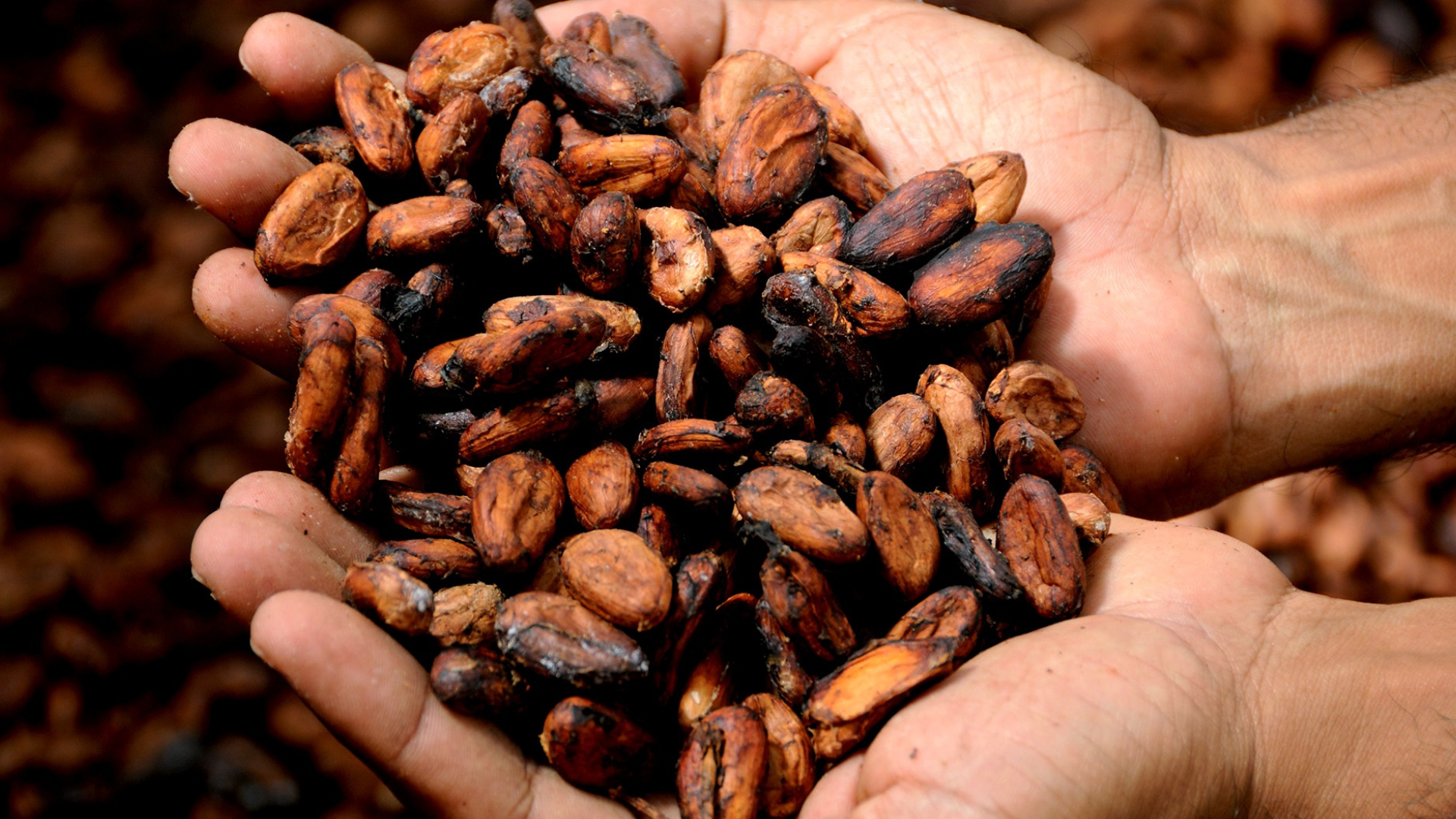
The cacao farmers have to manually machete off each cacao pod. Even in commercial, global scale, production. Machinery to make this process less labour intensive hasn’t been created yet. And the tools used by the farmers are just hand held machetes or knives. Once they have manually picked the fruit, they then cut the pod in half and pull out the beans and flesh. And that’s how the process starts.
And those white fleshy seeds you’ve just pulled out?
They are your base ingredients that start the chocolate making process. In the next part we’ll talk about how the farmers turn those seeds into beans and prepare them so they can be turned into chocolate and we’ll go through turning them into chocolate in the session after that!
But for now the key thing is the seeds from the cacao tree gives us chocolate.
And it takes a while. You need to wait 3 – 5 years to grow a mature cacao tree. They grow 30ish pods each harvest which take 5 – 6 months to grow and ripen.
And we haven’t even started turning those beans into chocolate!
The fact that the first chocolate bar was invented in the mid 1800s and yet we aren’t at all familiar with where it even comes from (despite eating chocolate or seeing chocolate everyday) IS INSANE. And for us, who hadn’t given it much of a thought before all of this, it’s actually pretty interesting.
So next time you think of a chocolate bar, think of walking through rows and rows of cacao trees, think of the hot heat, the colourful melon size pods hanging off the trunks and branches. Think about this because it’s just stunning and a shame that we haven’t been told much more about it…yet!
So stay tuned for the next part. And thanks heaps for talking beans with us!
Where to next?
Continuing on our four part trip – your next stop is….
And if you’re still not so sure, check out what events or makers are in your area:
Talk Beans with us!
Got any questions? Feedback? Want to hi say? Reach out below – we’re always happy to chat!
Upcoming Event/s
Chocolate Tasting, Educational Course, One of a Kind
‘4 August 2026’
The Chocolate Maker Experience by Dandelion Chocolate August 2026 – California, United States
A four-day guided workshop hosted at both of our San Francisco factories and led by industry experts Step into our Valencia Street factory for a rare opportunity to work directly […]
The Bean to Bar Process Articles
No Categories

‘6 August 2026’
The bean to bar process! Part Four: Small Batch Chocolate Making
How small batch chocolate makers are revolutionizing chocolate as we know it.
No Categories

‘6 August 2026’
The bean to bar process! Part Three: Fascinating Fermentation
This is where we try and make micro organisms more... interesting?
No Categories
‘6 August 2026’
The bean to bar process! Part Two: Chocolate Trees
Well technically, growing cacao beans.
More Stories
 Contents: Your Guide To Everything Beanstalkr And Exploring the World of Bean-to-Bar Chocolate:
  Beans Talkr Community Tasting Panel for the Craft Chocolat Challenge 2026
  The Next Wave of Chocolate: Health, Mindfulness, and Meaningful Making
  Serious Fun for Serious Flavor: Chocolate Workshops to Spark Your Creativity
Leave a Reply